Good flavour however a little too weak for my taste.
Great flavour and a nice strong coffee.
Very nice flavour however it was not strong enough for my taste.
As a self confessed coffee snob I think this coffee is tremendous.

Have an account? Log in to check out faster.
The short version
By Alex Cox, Founder of Raw Bean Coffee | Originally published March 2022 | Updated April 2026
We started Raw Bean because we were fed up with bad decaf. You know the one — the kind that tastes like it's been through a chemistry experiment and back. Somewhere along the way, we started reading the actual medical research on decaf. Turns out it's not just "coffee minus caffeine." It carries almost all the same health benefits as regular coffee, and for some things, it's the better option.
Below are six of those benefits, with the studies to back them up.
Coffee is one of the richest sources of polyphenols in the Western diet. These are the compounds that matter most for metabolic health.
A meta-analysis published in Diabetes Care looked at 28 studies covering over 1.1 million people. The finding: each daily cup of decaf was associated with a 6% lower risk of developing type 2 diabetes (Ding et al., 2014). Regular coffee was 7%. Not much in it.
A second meta-analysis, covering 1.18 million participants across 30 studies, found coffee drinkers had a 29% lower risk of type 2 diabetes overall. The results held for both caffeinated and decaffeinated coffee, and were consistent across men, women, and populations in Europe, the US, and Asia (Carlstrom & Larsson, 2018).
How does it work? Harvard's School of Public Health points to chlorogenic acid and magnesium, both of which improve insulin sensitivity and glucose metabolism. Some studies suggest decaf actually contains more chlorogenic acid than regular coffee, because the roasting profiles differ.
On the cancer front, the American Institute for Cancer Research reports strong evidence that coffee reduces the risk of liver and endometrial cancers, with some evidence for mouth, pharynx, and larynx cancers too. The protective compounds are chlorogenic acids and diterpenes (kahweol and cafestol), all present in decaf. A 2012 prospective study found that two or more cups of decaf per day was associated with a lower risk of colorectal cancer specifically (Sinha et al., 2012).
Sources:
This one sounds obvious, but the numbers are worth knowing.
A 2023 meta-analysis found that caffeine reduces total sleep time by an average of 45 minutes and shifts you out of deep, restorative sleep into lighter stages (Gardiner et al., 2023). And it lingers. Caffeine has a half-life of about 5-6 hours. A study in the Journal of Clinical Sleep Medicine showed that caffeine consumed even six hours before bed significantly disrupted sleep quality (Drake et al., 2013).
A standard cup of decaf contains roughly 2-15mg of caffeine. A regular cup has 80-100mg. You'd need to drink somewhere between 27 and 200 cups of decaf to match the caffeine in four regular coffees.
With Swiss Water Process decaf (the kind we use), no more than 0.1% caffeine is left, the strictest standard there is. At roughly 2mg per cup, your evening flat white is no longer the enemy of your REM cycle.
Sources:
If you've ever had acid reflux after a strong morning cup, you're not alone. Caffeine is a known trigger for the lower oesophageal sphincter to relax, allowing acid to creep up.
One study measured oesophageal acid exposure in GERD patients and found that regular coffee produced a median acid exposure time of 17.9%. Switching to decaf brought that down to just 3.1% (Pehl et al., 1997). If you love the taste of coffee but hate the heartburn, decaf is worth trying.
A separate study by Wendl et al. (1994) found that decaffeination significantly reduced gastro-oesophageal reflux. They also tested decaffeinated tea and plain caffeinated water, and neither had the same effect. So it's not purely about caffeine — something about the combination of compounds in regular coffee aggravates the digestive system, and decaffeination dials it back.
Sources:
A study published in the European Journal of Preventive Cardiology followed 449,563 people in the UK Biobank over 12.5 years. They found that all coffee types, including decaf, were associated with a reduction in cardiovascular disease.
Interestingly, decaf drinkers saw the lowest CVD risk at 2-3 cups per day. Unlike high-caffeine intake, decaf showed no increased risk of arrhythmia (Chieng et al., 2022). You get the heart-protective polyphenols without the palpitations.
A separate meta-analysis in Circulation confirmed that moderate coffee consumption (3-5 cups daily) was associated with the lowest cardiovascular disease risk, and decaf showed similar benefits (Ding et al., 2014).
Sources:
The FDA and EFSA recommend a limit of 400mg of caffeine per day for healthy adults (and 200mg for pregnant women). Four regular coffees and you're at the limit. After that, you're looking at jitters, anxiety, and a racing heart.
Because decaf contains so little caffeine, you can enjoy the ritual of coffee from sunrise to sunset without worrying about crossing the safety threshold.
Sources:
Caffeine is a diuretic and bladder irritant. It stimulates the smooth muscle in the bladder wall, which increases urgency (Lohsiriwat et al., 2011).
A 2013 study using NHANES data found that women consuming more than 329mg of caffeine daily were 70% more likely to have bladder issues (Gleason et al., 2013). A double-blind, randomised crossover study confirmed that switching from caffeinated to decaffeinated drinks significantly reduced urinary urgency and frequency (Miller et al., 2014).
The NHS recommends cutting caffeine below 100mg/day for people with overactive bladder symptoms, and specifically lists decaffeinated drinks as a bladder-friendly alternative.
Sources:
This one surprised us. A UK Biobank study of nearly half a million people found that coffee drinkers, including decaf drinkers, had a 21% lower risk of chronic liver disease and a 49% lower risk of dying from it (Kennedy et al., 2021).
A separate US study of 27,793 participants found that decaf coffee drinkers had significantly lower levels of liver enzymes associated with liver damage. The researchers concluded that "chemical compounds in coffee other than caffeine may help protect the liver" (Xiao et al., 2014).
And a 2019 study in Redox Biology found that decaf specifically protected against early non-alcoholic fatty liver disease by maintaining intestinal barrier function. Nothing to do with caffeine at all (Loomba et al., 2019).
Sources:
All the health benefits above come from compounds like chlorogenic acids, polyphenols, and diterpenes. These are present in the coffee bean itself, not in caffeine. Swiss Water Process decaffeination uses only water to remove caffeine. No methylene chloride, no ethyl acetate. That matters, because in 2024 the FDA proposed removing methylene chloride from the list of permitted food additives, and the EPA banned it for most industrial uses.
Swiss Water Process preserves the beneficial compounds that make these studies relevant, while avoiding chemical solvent residues entirely. It's why we use it for everything we make.
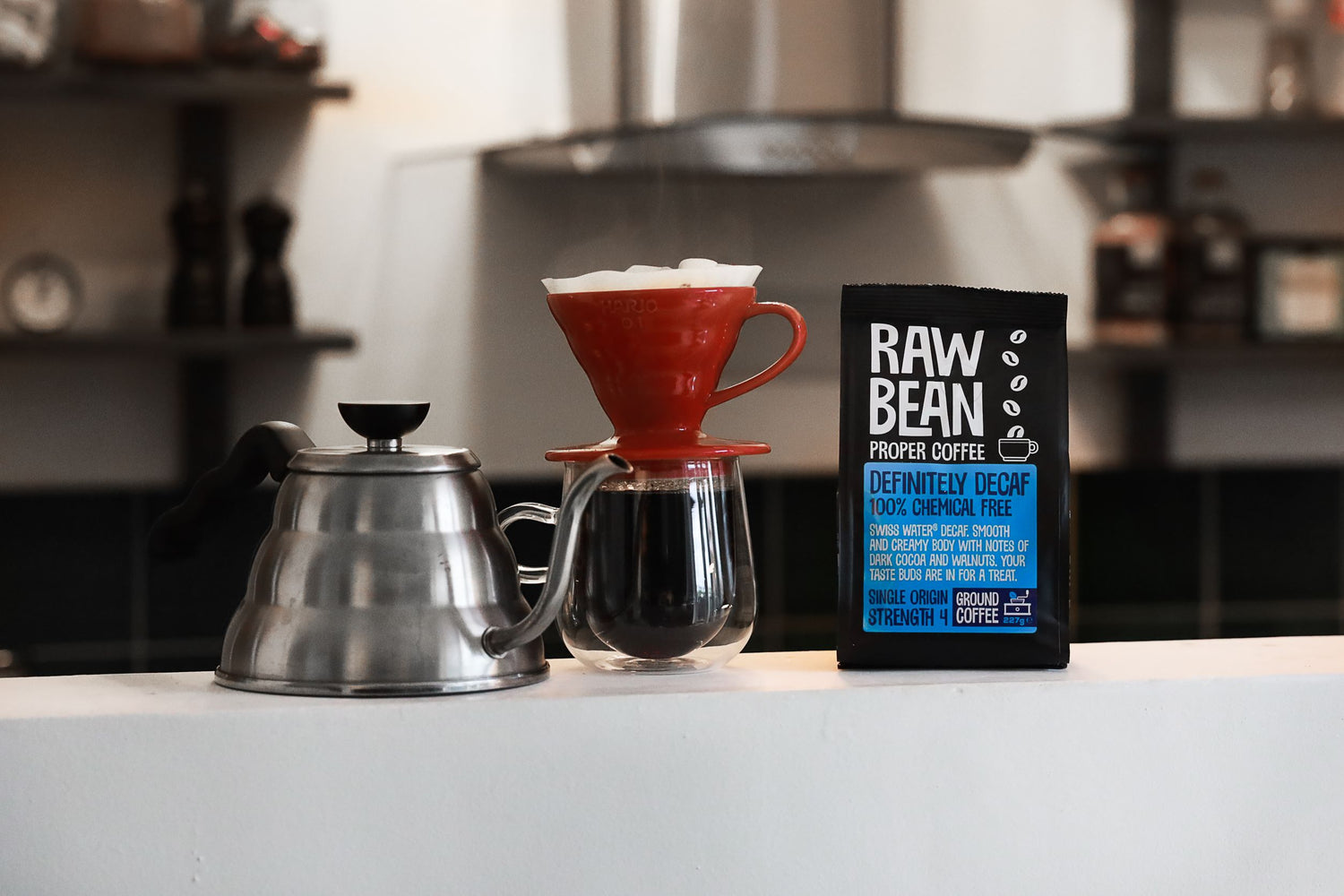
If you want to try it, our Definitely Decaf range is all Swiss Water — that’s the method every study above is referring to when they say “decaf”.
We're coffee people, not doctors. This isn't medical advice. But the pattern across all these studies is pretty clear: the good stuff in coffee comes from the bean, not the caffeine. Polyphenols, chlorogenic acids, antioxidants — they're all still there after decaffeination.
And for sleep, reflux, and bladder health, decaf is genuinely the better option. The NHS says so, the FDA says so, and a few million research participants seem to agree.
This article was last reviewed and updated in April 2026. All citations link to peer-reviewed journals, government health bodies, or university research.
Related reading:
The Swiss Water Process: how we decaffeinate coffee without the chemistry set
The Decaf FAQ: every question about decaffeinated coffee, answered
Coffee and health: 10 questions people always ask
10 tips for a better night's sleep
How much caffeine is in a decaf coffee?
Want to go deeper? Read our updated guide on whether decaf coffee is good for you, or shop our Definitely Decaf range.
It is. Decaf keeps almost all the benefits of regular coffee. The studies link it to a lower risk of type 2 diabetes, heart disease and liver disease. The good stuff comes from the bean, not the caffeine.
Yes. The polyphenols, chlorogenic acids and diterpenes all sit in the coffee bean itself, not in the caffeine. Take the caffeine out and they stay put, which is why the health research still applies to decaf.
Not from what the research shows. For sleep, acid reflux and bladder health it's actually the gentler choice. The one thing worth checking is how the caffeine was removed. Swiss Water uses only water, no chemical solvents like methylene chloride.
Mostly, yes. The compounds behind coffee's benefits — polyphenols, chlorogenic acids and antioxidants — live in the bean, not the caffeine. So decaf carries through the links to lower type 2 diabetes, heart and liver disease risk, while dropping caffeine's downsides like disrupted sleep and jitters.
Yes. Coffee, caffeinated or not, is associated with a lower risk of liver disease including fibrosis and cirrhosis, and the protective effect holds for decaf. That points to the bean's plant compounds doing the work rather than caffeine, so you keep the liver benefit with an evening cup.
It can be. Decaf is linked to a lower risk of heart disease and, unlike regular coffee, doesn't give some people the short-term blood-pressure and heart-rate bump caffeine can cause. For anyone watching their heart health who still wants coffee, decaf is the gentler choice.
For most people, yes. Decaffeinated coffee keeps nearly all the benefits of regular coffee and loses the caffeine that disrupts sleep and irritates sensitive stomachs. The one thing worth checking is how the caffeine was removed — Swiss Water uses only water, no chemical solvents.
Written for you? The Label Reader — for people who want to know exactly what has been done to their coffee.
Keep the evening cup, lose the caffeine. Our Definitely Decaf is Swiss Water processed to 99.9% caffeine-free — single origin, no solvents. Shop Swiss Water decaf →
Make Raw Bean a preferred source on Google One click, and Google shows our guides more often in your search results and AI answers.