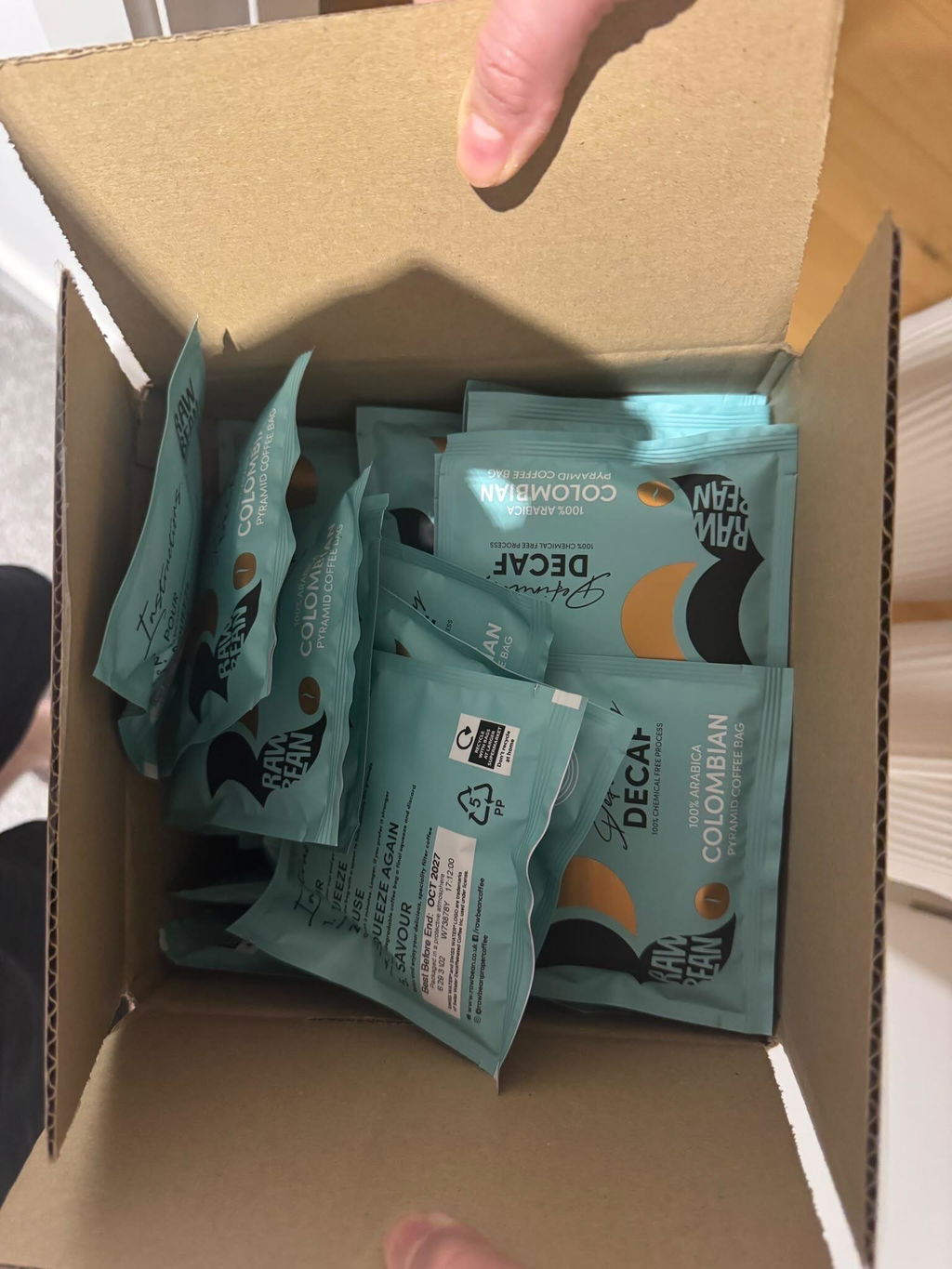
Decaf can be sustainable, but it depends less on the method's name than on the plant behind it. Water-based and CO2 processes have the strongest case. Sugarcane ethyl acetate is still a solvent process, however natural the name sounds, and methylene chloride is a clean-label dead end. Here's every method compared, awkward bits included.
Plenty of coffee bags say "sustainably sourced" and hope you won't ask a follow-up question. We'd rather show our working. We ship Swiss Water decaf by the tonne, so we have a horse in this race, and we'll still tell you where our own method uses more water and energy than we'd like.
How is decaf coffee made?
All decaf starts with green, unroasted beans. Before roasting, one of four things pulls the caffeine out: water, pressurised carbon dioxide, ethyl acetate or methylene chloride. Which of the four gets used decides most of the sustainability story, which is why this question has no one-word answer.
Most people have no idea any of this happens. Tristan Höver of Euromonitor International told Tea & Coffee Trade Journal (July/August 2026) that most consumers don't really know how decaf is made. The trade compares it to alcohol-free beer. You buy it for what it hasn't got, without ever asking how it lost it.
The full mechanics, water temperatures and all, live in our complete Swiss Water Process guide. This piece stays on the environmental question.
The four methods at a glance
Four methods dominate commercial decaffeination: water-based processing (Swiss Water is the best-known name), supercritical CO2, sugarcane ethyl acetate and methylene chloride. Two avoid chemical solvents entirely. Two don't. All four use energy, and pretending otherwise is where the greenwash starts.
| Method |
What removes the caffeine |
Water and energy |
Where the caffeine goes |
What shoppers make of it |
| Water-based (Swiss Water) |
Water and green coffee extract, no chemical solvents |
Significant water and energy, with the extract recycled through carbon filters |
Caught in the carbon filters |
Chemical-free, easy to trust |
| Supercritical CO2 |
Pressurised carbon dioxide, recaptured and reused in the process |
Energy is the weak point |
Drawn out by the CO2 |
Clean, but takes some explaining |
| Sugarcane ethyl acetate |
Ethyl acetate, bio-based when naturally derived from sugarcane |
Depends on the plant and how much solvent gets recovered |
Dissolved out with the solvent |
The word "solvent" puts people off |
| Methylene chloride |
A synthetic chemical solvent |
Our take: the issue is the solvent, not the water or energy |
Dissolved out with the solvent |
Legal within residue limits, hard sell on a clean label |
One thing the table can't show: the method's name is itself part of the marketing. Höver notes it matters most to specific groups, pregnant women among them, and to anyone after more natural nutrition. Which is exactly why the better methods get printed on the front of the bag and the worst one never does.
Is decaf coffee sustainable?
Decaf is as sustainable as the facility that made it. Tea & Coffee Trade Journal reports that most analysts believe real sustainability depends less on the method name alone and more on the full process behind it: energy use, water management, solvent recovery, transport, and how much quality gets lost along the way.
The stakes are growing. Fortune Business Insights valued the global decaf market at $6.27 billion in 2025 and projects $14.08 billion by 2034. Europe held 37.63% of it in 2025. That's a lot of caffeine coming out of a lot of beans, and how it comes out matters a little more every year.
Then there's the bit sustainability roundups usually skip: flavour. Nandini Roy Choudhury, senior analyst at Future Market Insights, defines the cleaner method as the one with "lower solvent exposure, lower residue risk, stronger recovery of process inputs, and less damage to cup quality." That last item is easy to miss. Decaf that loses too much character becomes harder to sell as premium and ends up as commercial waste. A bag nobody finishes is the least sustainable coffee there is.
So the question isn't which method sounds greenest. It's what the plant behind it actually does with its energy, its water and its solvent.
Which decaf method is most sustainable?
Water-based and supercritical CO2 processing have the strongest sustainability case, in Choudhury's verdict for Tea & Coffee Trade Journal. Neither relies on conventional organic solvents, and CO2 systems can reuse the carbon dioxide within the process. She puts bio-based ethyl acetate a step below them, and methylene chloride at the bottom of the pile.
Now the honest bit, our own method included. Choudhury is blunt that the front-runners' weak point is energy use, and that "a CO2 decaf plant using cleaner power and heat recovery is in a much better position than one running an energy-heavy process without those controls." The Tea & Coffee Trade Journal piece adds that water-based and CO2 systems can require significant water, energy or technical infrastructure.
Swiss Water answers part of that with recycling. The green coffee extract that absorbs the caffeine passes through carbon filters and, in Swiss Water's words, "continues the cycle with new beans, creating a sustainable, closed-loop process".
The facility matters as much as the flowchart. Descamex, one of the world's leading decaf suppliers, runs solar power generation at its Mexican plant. Same method on paper, smaller footprint in practice. Höver adds a commercial angle: water and CO2 methods are simply easier to communicate as natural and sustainable, which shapes what brands choose.
Then there's "sugarcane decaf". It sounds like a field of cane. It's ethyl acetate decaf: the beans still sit in a solvent while the caffeine comes out, and the sugarcane part only tells you where the solvent came from. Choudhury's checklist for any solvent route is a fair one: "where did the solvent come from, how much is recovered, and how transparent is the processor about emissions control?" Our answer is shorter. We picked a process with no solvent step at all, so we don't use it, however natural the label sounds.
And methylene chloride? Still legal in the UK and EU, with a residue limit of 2 mg per kilo of roasted coffee. But decaf drinkers increasingly want clean labels and processing transparency, which Choudhury says makes it "harder to defend from a brand and procurement point of view, even where it remains legally permitted." If it's the health and residue side you're weighing up, we've compared Swiss Water against chemical decaf properly elsewhere.
You don't need a chemistry degree and a clipboard to buy a bag of decaf. One question does most of the work: does the roaster name the method? A roaster who names it will usually answer everything else too. A bag that just says "decaffeinated" has answered you already.
What's next for greener decaf?
Not a new method. Analysts expect practical improvement of the existing four: lower-energy CO2 systems, better carbon filtration and less water. Longer term, coffee that barely contains caffeine in the first place could make decaffeination unnecessary, but nobody in the trade expects that on shelves any time soon.
Choudhury's view is that "the next wave is likely to be practical improvement. Lower-energy CO2 systems and improved carbon filtration approaches are the areas to watch." The trade press points to refinements like ZEN, a CO2 variant that uses less water and causes less bean swelling, which can mean better flavour because less gets washed out of the bean.
Höver sees the same direction: less water, less energy, better flavour retention, and sustainability stories consumers can actually follow. That last one matters. A method nobody understands is a method nobody rewards.
The long shot is coffee with no caffeine to remove. That could come from gene editing, or from wild species like Coffea charrieriana, a Cameroonian coffee that never got round to making caffeine in the first place. The trade's view is that it's a long way from commercial relevance. Until a plant does the work for us, decaffeination stays an industrial process, and the question stays the same: how clean is yours?
What we do at Raw Bean
Every decaf we sell is Swiss Water® Process, and we shipped around 34 tonnes of it in 2025. We chose the method because Swiss Water guarantees the green coffee leaving the process is 99.9% caffeine free, no chemical solvents involved, and because we believe it protects the flavour. Great Taste judges gave our decaf Perfect Pods a 2-star award in 2025.
We started in 2012 on a market stall in Winchester, and decaf has been the backbone ever since. Our decaf was on Waitrose shelves by 2016. The process behind it uses, in Swiss Water's own words, "only water, temperature, and time".
We won't pretend that's impact-free. It uses water. It uses energy. Everything on this page does. What it doesn't use is a chemical solvent, and on the evidence above, water-based decaf sits with CO2 at the credible end of the table.
Ready to taste the difference we believe it makes? The whole range lives in our decaffeinated collection, and the longer story of the process is on our Swiss Water decaf hub. Take life one cup at a time. And if that cup's a decaf, make it a proper one.