We often get asked, does decaffeinated coffee have caffeine in it? In this blog we talk about how much residual caffeine remains in decaf coffees and how much of this may end up in your final cup of coffee. We also discuss which regular coffees to choose if you simply want to manage your caffeine intake.
By Alex, Founder of Raw Bean Coffee | Updated April 2026
A typical cup of decaf contains 2–7mg of caffeine, compared to around 95mg in a regular brewed coffee. That's a reduction of roughly 93 to 98%, depending on the decaffeination method. Here's what that looks like in practice.
The numbers
How decaf stacks up against everything else you might reach for during the day:
| Drink |
Typical serving |
Caffeine (mg) |
| Regular brewed coffee |
240ml (8 fl oz) |
80–100 |
| Espresso |
30ml (1 shot) |
63 |
| Black tea |
240ml (8 fl oz) |
40–70 |
| Green tea |
240ml (8 fl oz) |
25–45 |
| Cola |
330ml can |
32–42 |
| Dark chocolate (70%) |
28g (1 oz) |
12–25 |
| Decaf coffee |
240ml (8 fl oz) |
2–7 |
So decaf has less caffeine than a square of dark chocolate, and considerably less than half a can of Coke. Even at the top of its range, you'd need to drink around 55–60 cups of decaf in a single day to approach the 400mg daily limit that EFSA considers safe for healthy adults.
The FDA's stated range is slightly wider — 2–15mg per cup — because they're accounting for variation across all decaf products on the market, including lower-quality processing methods. A properly Swiss Water processed decaf consistently sits at the lower end.
Why isn't it zero?
Decaffeination removes almost all caffeine, but not quite every last molecule. That's not a flaw — it's chemistry.
Caffeine is embedded throughout the coffee bean, bound to proteins and other compounds that contribute to flavour. The challenge with decaffeination has always been removing the caffeine without stripping away everything else — the oils, the sugars, the complexity that makes a good cup worth drinking.
In the UK and EU, roasted decaf is held to a maximum of 0.1% caffeine by dry weight, and instant coffee to 0.30%. That is the strictest standard there is. In the US, the FDA requires at least 97% removal to use the "decaffeinated" label, which is a slightly lower bar.
In practice, the best decaf processing achieves the higher end of that range. The amount left over is, for most people, undetectable. You'd have to be extremely caffeine-sensitive to notice 2–7mg in a cup.
Does the method affect how much caffeine remains?
Yes, to some degree. There are broadly two approaches to decaffeination: water-based and solvent-based.
Swiss Water Process uses only water, temperature, and time. Green beans are soaked in a caffeine-free "Green Coffee Extract" that draws caffeine out through osmosis — no chemical solvents at any stage. This method consistently leaves no more than 0.1% caffeine, the strictest standard there is.
Solvent-based methods, typically using methylene chloride or ethyl acetate, are more widely used in commodity decaf. They're effective and meet FDA requirements, typically achieving 97–99% removal. They're also the reason cheaper supermarket decafs sometimes taste flat: the solvents can strip flavour compounds alongside the caffeine.
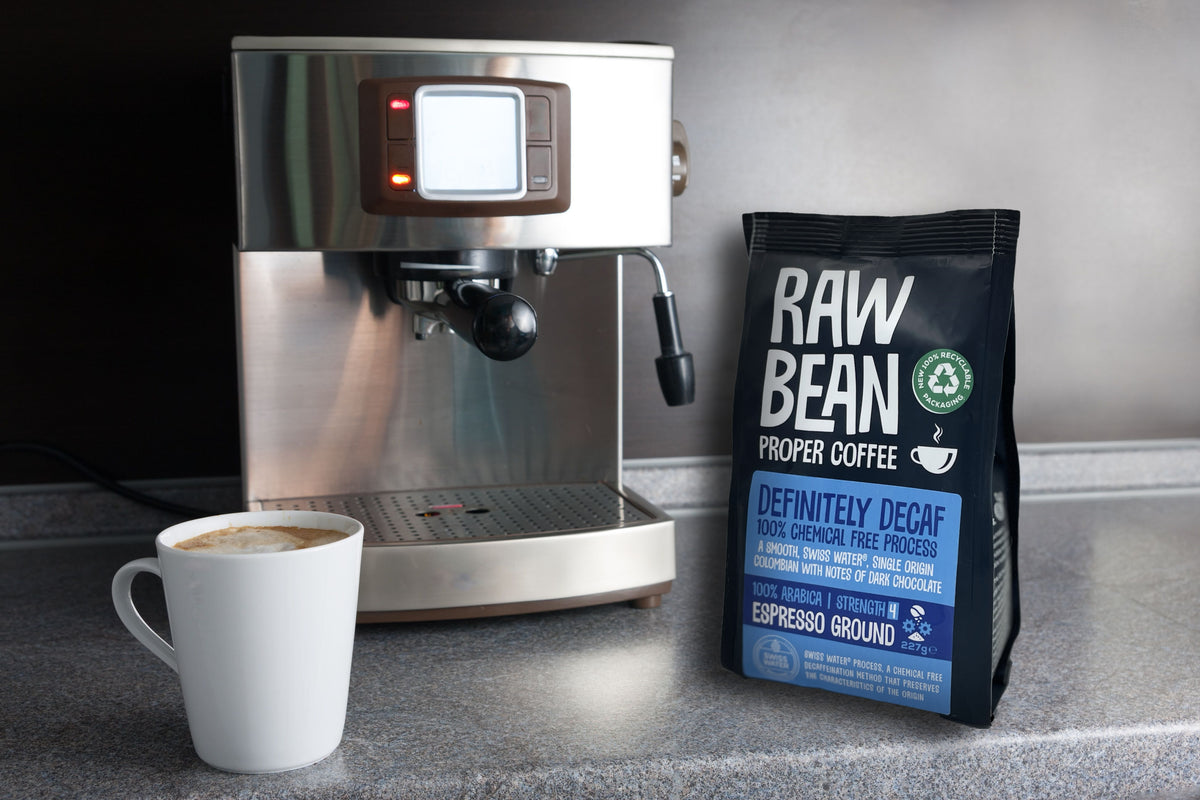
For our Definitely Decaf range, we use Swiss Water exclusively. Not just because of the higher caffeine removal, but because it's the only method that genuinely preserves the character of a well-sourced bean.
Want the full breakdown? We've covered the processing methods in detail here: Swiss Water vs chemical decaf — what's the difference?
Who actually needs to know this?
For most people, the caffeine level in decaf is a non-issue. But a few groups do need to think about it.
If you're pregnant, the NHS recommends staying under 200mg of caffeine per day. At 2–7mg per cup, decaf is well within that — you'd need around 30–100 cups to approach the limit. The ACOG takes the same position, recommending under 200mg daily as a precaution. If you're cutting caffeine entirely, decaf won't be a problem. If you're just managing your overall intake, it barely registers.
Some medications interact with caffeine, including certain antibiotics, heart medications, and stimulants. If you've been advised to reduce your intake, the levels in decaf are low enough that they're unlikely to cause issues — but check with your GP if you're uncertain.
People who metabolise caffeine more slowly (it's genetic) can find that even small amounts affect their sleep or anxiety. At 2–7mg per cup, decaf is the obvious choice. If you're particularly sensitive, it's also worth thinking about timing, not just quantity. We've written about the caffeine-sleep connection in more detail here: Decaf coffee and sleep
And if you're a late-night coffee drinker: Drake et al. (2013) found that caffeine consumed even six hours before bed reduces total sleep time by a measurable amount. Switching to decaf after 2pm removes that risk almost entirely, without giving up the ritual of an evening cup.
Shop Swiss Water Decaf →
Frequently asked questions
Is decaf coffee completely caffeine-free?
No. A standard cup of decaf contains around 2–7mg of caffeine — compared to 80–100mg in a regular brewed coffee. Swiss Water processed decaf leaves no more than 0.1% caffeine, the strictest standard there is. It's as close to zero as the science currently allows without compromising the flavour of the bean.
Can I drink decaf if I'm pregnant?
Yes. The NHS recommends staying under 200mg of caffeine per day during pregnancy. A cup of decaf contains 2–7mg — so even 10 cups would only put you at 20–70mg, well below the guideline. Decaf is widely considered a safe, sensible choice for pregnant women who still want to enjoy coffee.
How many cups of decaf can I have per day?
There's no established upper limit for decaf. Even 5–6 cups a day would only deliver 10–40mg of caffeine — a tiny fraction of the 400mg daily threshold that EFSA considers safe for healthy adults. If you're avoiding caffeine for medical reasons, check with your GP, but for most people there's no practical ceiling.
Does decaf have more caffeine than tea?
No — significantly less. A cup of black tea typically contains 40–70mg of caffeine. Green tea is 25–45mg. Decaf coffee comes in at 2–7mg. If you've been drinking tea as a caffeine-free alternative to coffee, decaf is actually the better option by a long margin.
Does the brand or processing method affect how much caffeine is in decaf?
Yes. Swiss Water processed decaf leaves no more than 0.1% caffeine, the strictest standard there is, and tends to sit at the lower end of the 2–7mg range. Solvent-based decaf meets FDA and EU minimums (97–99% removal) but may contain slightly more residual caffeine, and the taste is often less nuanced. If precise caffeine reduction matters to you — or you simply want the best-tasting decaf — Swiss Water is the standard to look for.
What about decaf espresso?
Espresso is a more concentrated brew, but because the serving size is smaller (around 30ml vs 240ml), the absolute caffeine content in a decaf shot is still very low — typically 1–4mg. You'd need a lot of decaf espresso shots to accumulate any meaningful caffeine intake.
Does decaf coffee have caffeine?
Yes, but barely. A cup of decaf has around 2–7mg of caffeine, against 80–100mg in regular coffee. Decaffeination removes the great majority of it, leaving no more than 0.1% caffeine under the strictest EU and UK standard, so a trace is left rather than none. For almost everyone that amount is far too small to have any noticeable effect.
How much caffeine is in a cup of decaf coffee?
Around 2–7mg per cup. That compares with 80–100mg in a regular brewed coffee, 40–70mg in black tea and 25–45mg in green tea. Swiss Water processed decaf sits at the low end of that range because it leaves no more than 0.1% caffeine, the strictest standard there is.
Does decaf coffee have calories?
Almost none. A cup of black decaf has only a couple of calories, the same as regular black coffee — taking the caffeine out doesn't change that. Calories only climb once you add milk, sugar or syrups.
The Raw Bean approach
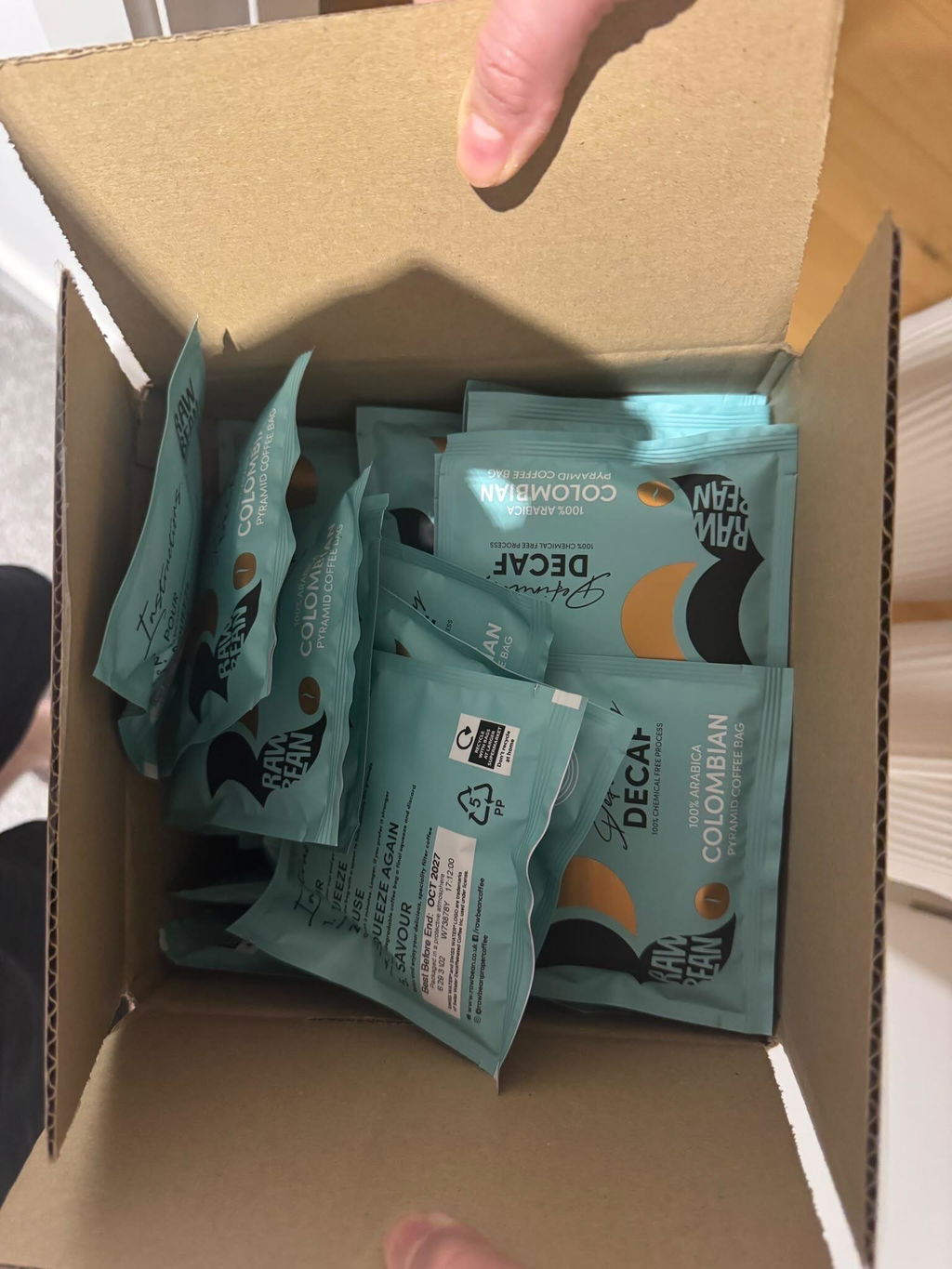
We believe you shouldn't have to choose between a good cup and a good night's sleep — or between taste and conscience. Our Definitely Decaf range is single origin from El Eden, Colombia, Swiss Water processed to leave no more than 0.1% caffeine, available as whole beans, ground, pyramid bags, and Nespresso-compatible pods.
No solvents. No compromise on flavour. Just a properly good decaf.
Curious about why decaf is worth drinking beyond the sleep benefits? Start here: Is decaf coffee actually good for you?
Explore Definitely Decaf →
Sources
-
EFSA Scientific Opinion on Caffeine (2015) — 400mg/day safe for healthy adults; single doses up to 200mg generally safe. EFSA Journal
-
FDA: Spilling the Beans — Decaf typically 2–15mg per 8 fl oz serving; 97% removal required for "decaffeinated" label. FDA
-
The Coffee Extracts and Chicory Extracts (England) Regulations 2000 — "decaffeinated" coffee extracts and instant coffee: residual anhydrous caffeine not to exceed 0.30% of coffee-based dry matter. legislation.gov.uk
-
USDA FoodData Central — Caffeine content of foods and beverages. USDA
-
Swiss Water Process — 99.9% caffeine-free, chemical-free. swisswater.com
-
NHS Pregnancy Guidance — Under 200mg caffeine per day recommended during pregnancy. NHS
-
ACOG: Caffeine in Pregnancy — Under 200mg/day recommended. ACOG
-
Mayo Clinic — Caffeine content reference chart. Mayo Clinic
-
Drake et al. (2013) — Caffeine consumed 6 hours before bed reduces sleep time. Journal of Clinical Sleep Medicine. DOI
Related reading:
Written for you? Bump & Brew — if you are pregnant or feeding and the caffeine number is the whole question.